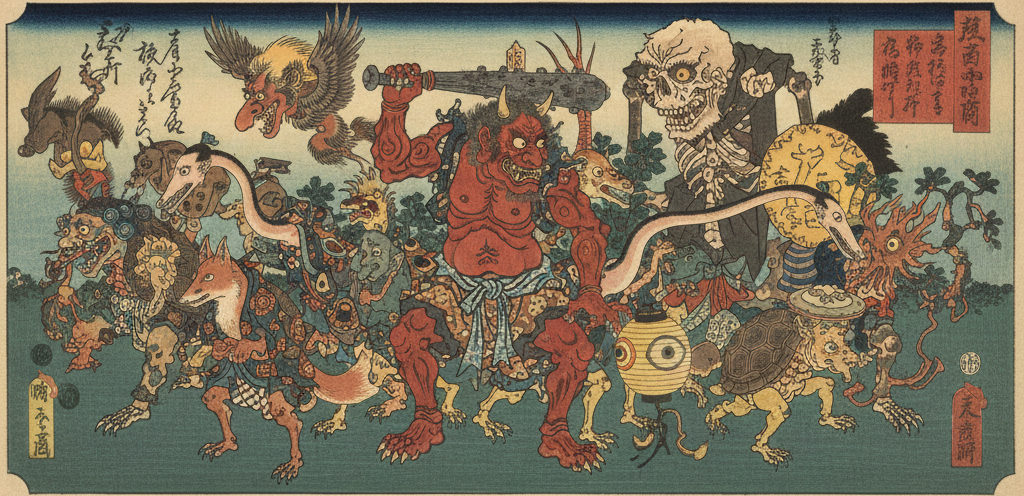
Quick Facts: Defining the Yokai
The term Yokai (妖怪) is an umbrella term in Japanese folklore, encompassing a vast and diverse array of supernatural beings, monsters, spirits, and phenomena. Unlike the singular concept of a “ghost” or “demon” in the West, Yokai represent virtually anything unexplainable or wondrous.
- Broad Definition: A class of supernatural entities ranging from malevolent ogres (Oni) to benign spirits (Tsukumogami).
- Key Characteristic: They often possess a visible, physical form or can manipulate objects in the physical world, setting them apart from purely ethereal ghosts.
- Origin: Born from ancient folk religion, misunderstandings of natural phenomena, historical events, and popular literature.
The Origin of the Word: From Mythology to Modern Day
The word Yokai is composed of two Kanji characters: Yō (妖), meaning “bewitching,” “attraction,” or “calamity,” and Kai (怪), meaning “mystery,” “wonder,” or “specter.”
The concept has evolved over centuries:
- Early Records (Heian Period): Supernatural beings were often categorized under broader terms like mononoke (物怪), meaning “thing that changes,” used to describe shapeshifting animals or spirits causing illness.
- Edo Period Flourishing: The era saw a boom in printed woodblock scrolls and illustrated encyclopedias of monsters, most notably works by the artist Toriyama Sekien. This period cemented the term “Yokai” and systematically cataloged these creatures.
- Modern Interpretations: Since the mid-20th century, particularly due to the work of manga artist Shigeru Mizuki (GeGeGe no Kitaro), Yokai have become an enduring and recognized element of Japanese pop culture worldwide.
Yokai vs. Other Supernatural Creatures (The Key Differences)
For non-Japanese audiences, distinguishing Yokai from other supernatural terms is crucial for accurate understanding.
Yokai vs. Yurei (Japanese Ghost)
While a Yurei (幽霊) is a type of Yokai, the distinction is typically made based on origin:
| Feature | Yurei (Ghost) | Yokai (General) |
|---|---|---|
| Origin | Always a deceased human being whose spirit cannot find peace (due to strong attachment, trauma, or improper rites). | Can be an animal, plant, object, natural phenomenon, or a deceased human (a type of Yokai). |
| Goal/Motivation | Usually seeks revenge, to complete an unfinished task, or to find eternal rest. | Motivation varies widely: from playful tricks to causing calamities to simply existing. |
| Appearance | Often appears as a misty, translucent figure, usually wearing a white burial kimono. | Appearance is vastly diverse (e.g., three-eyed giants, nine-tailed foxes, talking umbrellas). |
Yokai vs. Oni (Japanese Demon/Ogre)
Oni (鬼) are a powerful class of Yokai, but they hold a specific role:
- Oni are typically large, fearsome, troll-like or ogre-like beings known for their horns, fangs, and carrying iron clubs (kanabō).
- They often serve as the demons of Buddhist hell (Jigoku) or as antagonists in folktales, symbolizing evil and punishment.
- While Oni are Yokai, not all Yokai are Oni. Many Yokai are far less menacing and sometimes even helpful or benevolent.
Yokai vs. Kami (Gods/Spirits)
The line between Yokai and Kami (神, Gods/Spirits) is often blurred but important:
- Kami are objects of Shinto worship, revered for their immense power and ability to bestow blessings (or curses). They reside in shrines.
- Yokai are generally not worshipped, though some (like the Tengu) have complex relationships with shrines and deities. A Kami that has fallen from grace or acts mischievously might be categorized as a powerful Yokai.
How Yokai are Categorized (Classification of the Supernatural)
Yokai are generally classified based on their nature or origin. This structure helps researchers and readers navigate the vast archive of Japanese creatures:
- Hito-gata (Human-shaped): Yokai that appear mostly human, such as the Yuki-Onna (Snow Woman).
- Dōbutsu-gata (Animal-shaped): Shapeshifting beasts like the Kitsune (Fox) and Tanuki (Raccoon Dog), known for their trickery.
- Shokubutsu-gata (Plant-shaped): Rare, derived from plants.
- Dōgu-gata (Object/Tool-shaped): Known as Tsukumogami (付喪神), these are tools that have gained a spirit after turning 100 years old (e.g., Kasa-obake, the umbrella monster).
- Bamen-gata (Location-based): Yokai tied to a specific location or natural phenomenon, such as the Kappa (River Imp) or Yamauba (Mountain Hag).
Yokai in Pop Culture: Why They Matter Today
Yokai continue to fascinate audiences globally, largely due to their deep presence in media:
- Manga & Anime: GeGeGe no Kitaro (the original popularizer), InuYasha, Natsume’s Book of Friends.
- Video Games: Yokai are central figures or enemies in major titles like Pokémon, the Nioh series, Yo-Kai Watch, and Okami.
- Modern Relevance: They serve as powerful narrative devices, offering commentary on modern life, environmental fears, or the tension between tradition and technology. Their continued adaptability ensures their survival in the modern imagination.
References and Further Reading
- Mizuki, S. (2004). Yōkai Dai-Zukan (Illustrated Encyclopedia of Yokai).
- Foster, M. D. (2015). The Book of Yokai: Mysterious Creatures of Japanese Folklore. University of California Press.
- Reider, N. M. (2010). Japanese Demon Lore: Oni from Ancient Times to the Present. Utah State University Press.